
- A Fed rate decision prediction market lets traders buy and sell contracts tied to a specified Federal Reserve decision.
- On September 16, 2026, the FOMC voted 12–0 to raise its target range by 0.25 percentage points to 3.75%–4%.[1]
- The next scheduled FOMC meeting is October 27–28, 2026.[2]
- A market about a hike before year-end asks a different question from a market about a hike at one meeting.
- At a hypothetical 90¢ entry price, a $1 binary contract offers 10¢ profit if it wins and loses 90¢ if it loses, before fees.
New to event contracts? Start with what is a prediction market.
What is a Fed rate decision contract?
A Fed rate decision contract asks what the Federal Open Market Committee, or FOMC, will do at a specified meeting. On Kalshi's ordinary $1 binary event contracts, the purchased side pays $1 if it resolves correctly and $0 otherwise. A hypothetical Yes price of 60¢ corresponds to roughly 60% implied probability. That is a market estimate, not certainty.[3]
The FOMC sets a target range for the federal funds rate. The actual overnight rate is a market rate influenced by the Fed's policy tools. The committee normally holds eight scheduled meetings each year, with additional meetings when needed.[2][4]
What happened at the September 2026 Fed meeting?
The Fed's September 16 statement records a unanimous 12–0 decision to raise the target range by 25 basis points to 3.75%–4%. It described inflation as elevated.[1]
The July 29 statement provides useful context. The committee had held the range at 3.50%–3.75% by a 9–3 vote. The three dissenters preferred an increase of 0.25 percentage points.[5]
September's Summary of Economic Projections lists a median year-end federal funds rate projection of 4.1%, rounded to one decimal place. That figure describes the projected midpoint of a target range, not its upper bound. Projections are individual policy assessments, not a promise of a future decision.[6]
Did prediction markets anticipate the hike?
Some earlier market prices assigned meaningful probability to a hike, but the question and date matter:
| Source date | Question being priced | Reported snapshot |
|---|---|---|
| June 18, 2026 | Next hike before 2027 | 54%, according to Kalshi's market report[7] |
| August 29, 2026 | A 25-basis-point hike at the September meeting | 47%, according to Kalshi's market report[8] |
These are historical snapshots from different contracts. They are not a like-for-like price trend, live quotes, or proof that buying earlier was a better decision. The longer year-end window could include a hike in a later month even if September ended in a hold.
CME FedWatch provides another reference point. It derives probabilities from 30-Day Federal Funds futures using a model and assumptions. It is not a quote for a Kalshi contract. Match the meeting, target range and observation time before comparing the two.[9]
Worked example: how entry price changes risk
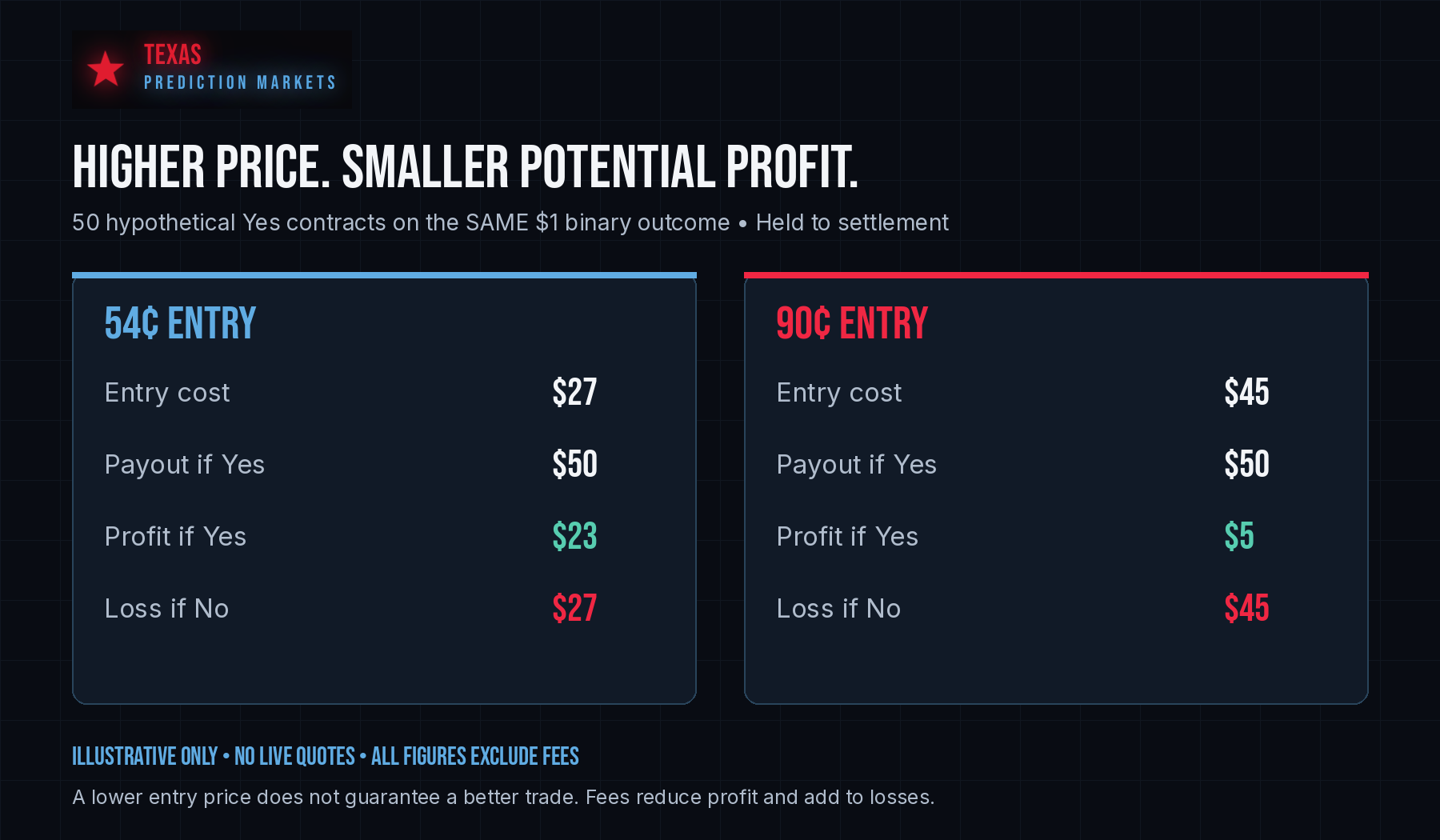
Hypothetical prices for the same $1 binary outcome. These are not documented historical trades. All amounts exclude fees.
| 50 Yes contracts | At 54¢ each | At 90¢ each |
|---|---|---|
| Entry cost | $27 | $45 |
| Payout if Yes resolves correctly | $50 | $50 |
| Profit if Yes resolves correctly | $23 | $5 |
| Loss if No resolves correctly | $27 | $45 |
A lower entry price offers more potential profit per contract, but may also reflect a lower likelihood of winning. Price alone does not make a trade attractive.
For the 90¢ example, nine winning contracts produce 90¢ total profit before fees. One losing contract costs 90¢. That comparison assumes equal contract size and the same entry price on every contract. Fees make the result less favorable.
Why do Fed decisions matter to Texans?
The Fed's policy influences broader interest rates and borrowing conditions. For Texas households and businesses, changes can affect the cost of financing purchases and investment. The timing and size of the effect vary by product and lender.[4][10]
A change to the federal funds target range does not mean every loan, mortgage or savings rate changes by the same amount on the same day. Understanding the decision is useful even if you never trade a contract.
What Fed contracts can you find on Kalshi?
Kalshi's Fed category and October decision page list markets linked to Fed policy.[11] Contract families can ask about a decision at one meeting, the timing of a move, or a rate level after a deadline. Check what is currently listed, open and available to your account.
The October decision page was accessible during our September 24 research. We have not embedded its prices because they change. Read the exact outcome definitions and settlement rules on the market page before treating any displayed percentage as relevant to your question.
Read the rules: a decision and a final rate are different questions
A meeting decision contract might ask whether the FOMC raises its target by exactly 0.25 percentage points at the October meeting. Other outcomes may include a hold, a larger hike or a cut. Read every outcome; do not assume hikes and holds exhaust all possibilities.
A final rate level contract might instead ask whether the upper end of the target range is at least 4.50% after December. It measures a level at a specified time, not necessarily the size of one meeting's move.
Worked example: same final rate, different paths
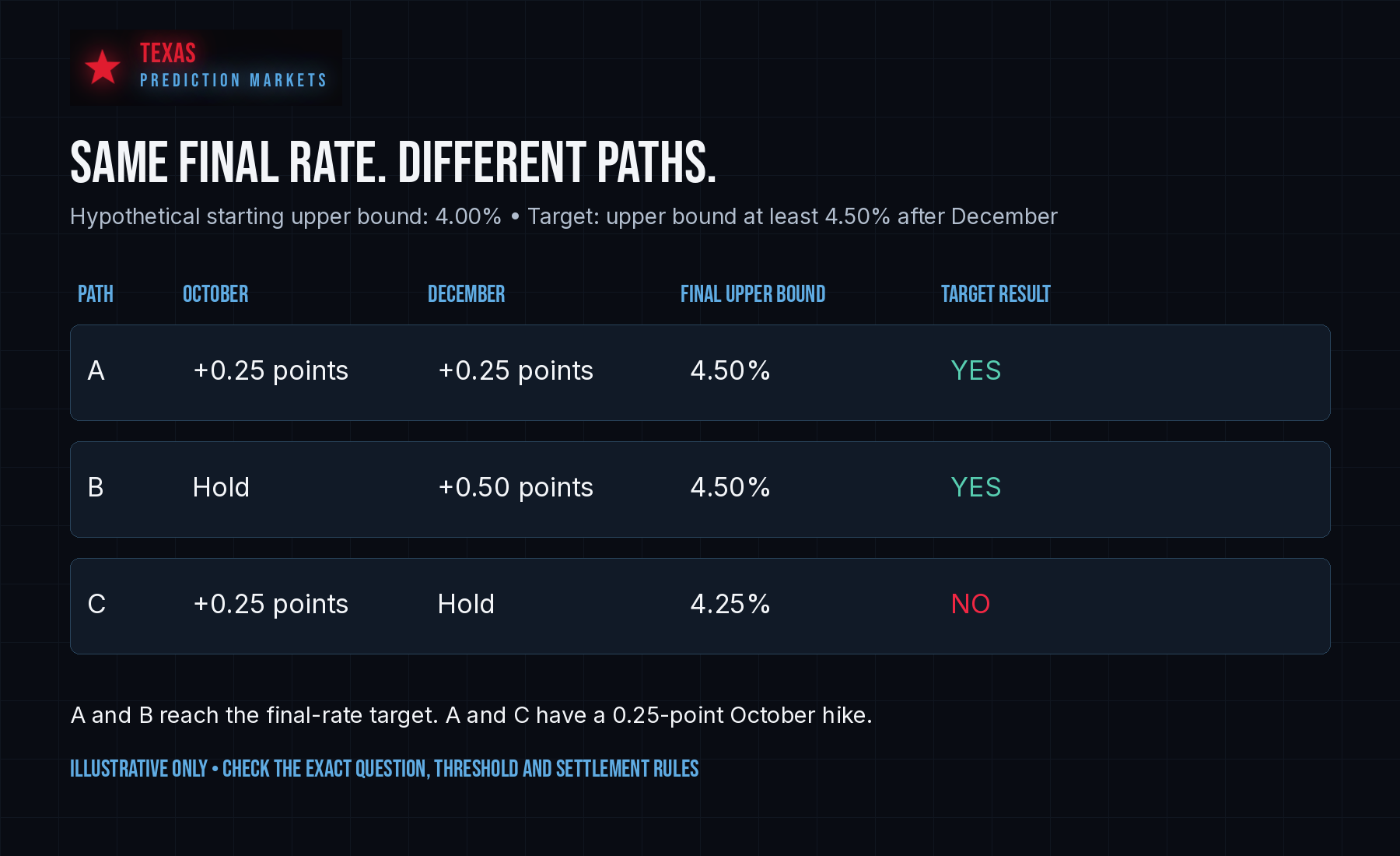
Hypothetical rules and paths, not a claim that this exact market is listed. Starting upper bound: 4.00%.
| Path | October | December | Final upper bound | At least 4.50%? |
|---|---|---|---|---|
| A | +0.25 pp | +0.25 pp | 4.50% | Yes |
| B | Hold | +0.50 pp | 4.50% | Yes |
| C | +0.25 pp | Hold | 4.25% | No |
Paths A and B reach the hypothetical rate-level target. Paths A and C include a 0.25-point October hike. Always check whether the contract uses a target range, its upper bound, its midpoint or another rate measure.
When is the next Fed meeting?
| Scheduled meeting | Decision day | Usual release time (most of Texas) | Projections? |
|---|---|---|---|
| October 27–28, 2026 | Wednesday, October 28 | 1 p.m. Central | No scheduled SEP |
| December 8–9, 2026 | Wednesday, December 9 | 1 p.m. Central | Scheduled SEP |
The meeting dates and projection schedule come from the Fed calendar.[2] Scheduled statements normally arrive at 2 p.m. Eastern, equivalent to 1 p.m. Central and noon Mountain in El Paso. Press conferences normally follow at 2:30 p.m. Eastern. Confirm the official event schedule before relying on a release time; a platform countdown is not the Fed's calendar.[12]
How can readers assess Fed rate contracts carefully?
- Start with the exact question. Identify the meeting, rate measure, threshold, settlement source and deadline.
- Separate probability from certainty. A high price still leaves the possibility of a full loss of the purchase cost, plus fees.
- Compare compatible information. CME FedWatch uses futures and a model; Kalshi uses event-contract prices. Check that the questions and timestamps match.[9]
- Check orders, not only a headline percentage. Review the price and size you can actually trade. A limit order controls the price at which you are willing to trade but does not guarantee execution.
- Include fees. Kalshi's fees vary by market and transaction. Check the current fee schedule before calculating a net result.[13] See Kalshi fees explained.
View Kalshi's current Fed markets
Fed markets are listed under Economics in the Kalshi app.
Trade on KalshiAffiliate link. See our disclosure.
Certain limitations apply. The offer is available to new users only, subject to the terms and conditions at kalshi.com/tc/500. 18+ only. Restrictions and eligibility requirements apply. Event contract trading involves significant risk and is not appropriate for everyone. Please carefully consider if it is appropriate for you in light of your personal financial circumstances. Kalshi products are not available in all jurisdictions. See kalshi.com/regulatory for more information.
Compare prediction market platforms and read our Kalshi Texas guide for further context.
Kalshi and Polymarket: verify the actual product
This guide documents Kalshi's Fed market page. Do not assume an international Polymarket market is also available through Polymarket US. An identical-looking topic can have different eligibility, questions and settlement rules. Check the specific US product before treating it as an option for Texas readers.
Trading risk
Kalshi: 18+. Eligibility restrictions apply, and products are not available everywhere. Event-contract trading can result in losing the full entry cost, including fees, and may be unsuitable for your financial circumstances. This guide is educational and does not recommend a particular trade. Read Kalshi's current regulatory and eligibility information.[11][14]
Sources
- September 16 FOMC statement
- Official FOMC calendar
- Kalshi event-contract explanation
- Fed policy-rate explanation
- July 29 FOMC statement
- September projections
- Kalshi June 18 historical market report
- Kalshi August 29 historical market report
- CME FedWatch methodology
- Fed explanation of interest rates
- Kalshi October 2026 decision market and risk notice
- Fed calendar showing normal statement/press-conference times
- Kalshi fee guidance
- Kalshi individual eligibility