
- A prediction market is a regulated exchange where you buy and sell Yes/No contracts on real-world events.
- Every contract settles at $1 if the outcome happens and $0 if it doesn't.
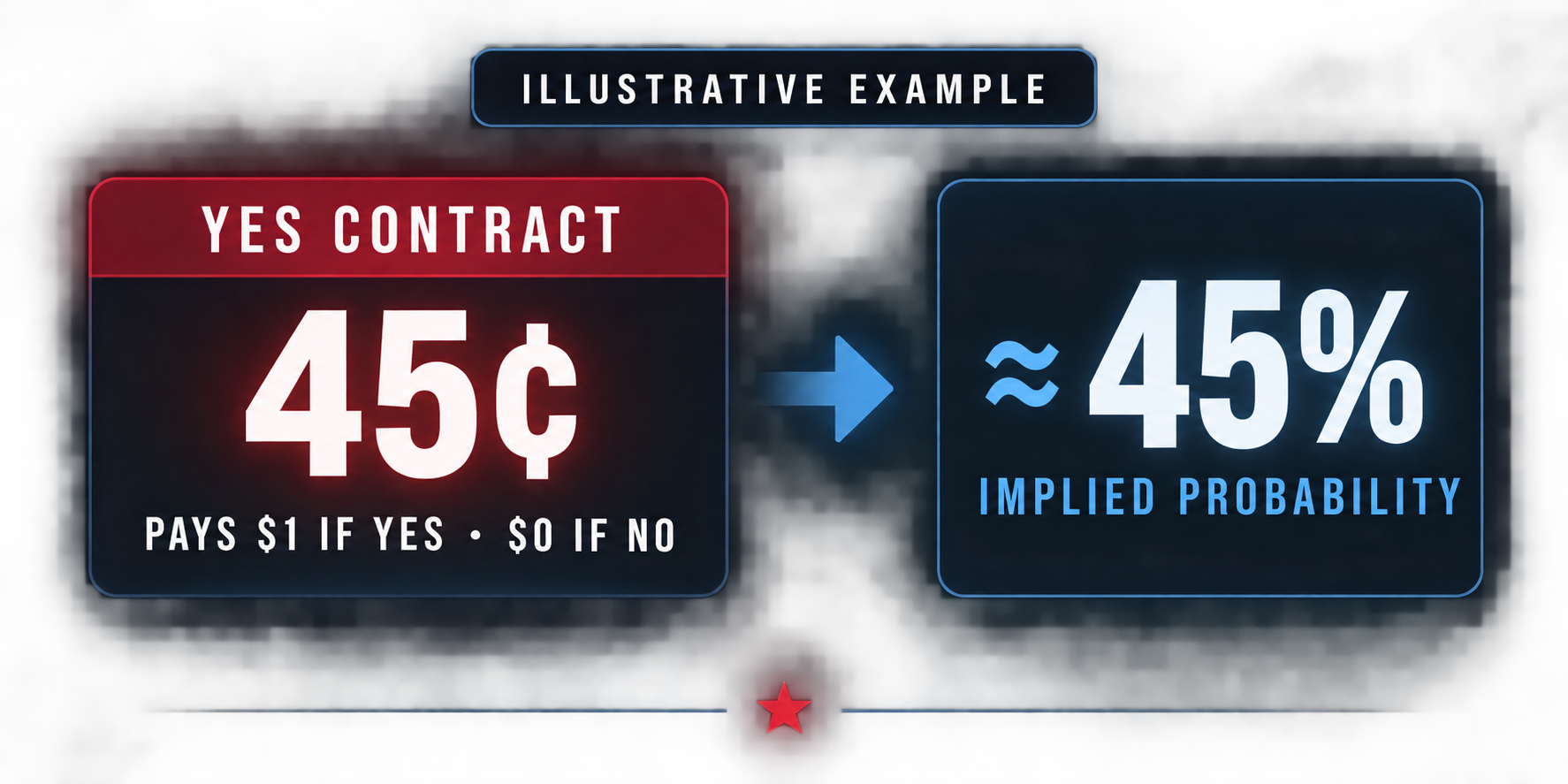
- The price is the market's implied probability. A contract at 45¢ means traders see roughly a 45% chance.
- You can hold a contract until it settles or sell it early.
- As of September 2026, Kalshi and Polymarket US are CFTC-regulated exchanges available to Texans. Texas has taken no enforcement action against them, but lawmakers are studying prediction markets ahead of the 2027 legislative session.
- This site covers prediction markets for adults 21 and older.
New to this? Start here. Most guides on this site assume you already know what "trading a contract" means. This one doesn't.
What is a prediction market?
A prediction market is an exchange where people trade contracts tied to a yes-or-no question about the future. Each contract pays $1 if the answer is Yes and $0 if it's No. Traders set the price by buying and selling, so the price works as a live, crowd-sourced estimate of how likely the event is.
That's the whole idea. Everything else on this page is detail.
How do prediction markets work?
Every contract asks one question with a clear, checkable answer. Some examples a Texan might trade:
- Will Ken Paxton win the 2026 US Senate race in Texas?
- Will the Houston Texans win the AFC South?
- What will the high temperature be in Houston today?
- Will the Federal Reserve cut interest rates before year-end?
Contracts trade between 1¢ and 99¢. When the outcome is known, winning contracts pay $1 each. Losing contracts pay $0.
Worked example: buying a Yes contract
Prices in this guide are illustrative, not live quotes.
Ken Paxton, the Republican nominee, faces Democratic nominee James Talarico in the US Senate general election on November 3, 2026. Say the "Yes — Paxton wins" contract trades at 45¢.
- You buy 20 Yes contracts at 45¢. Cost: $9.00.
- If Paxton wins, each contract pays $1. You receive $20.00. Profit: $11.00 before fees.
- If Paxton loses, the contracts settle at $0. You lose your $9.00.
Two rules follow from this. The most you can lose is what you paid, plus fees. The most any contract can pay is $1.
Yes and No are two sides of one contract
If Yes trades at 45¢, No trades at about 55¢. The two sides add up to roughly $1, because exactly one of them will pay out. Buying No at 55¢ is the same view as "Paxton loses," priced from the other side.
What does a prediction market price mean?
The price is the implied probability. Read the price in cents as a percentage.
- 8¢ = the market sees about an 8% chance.
- 45¢ = about 45%.
- 92¢ = about 92%.
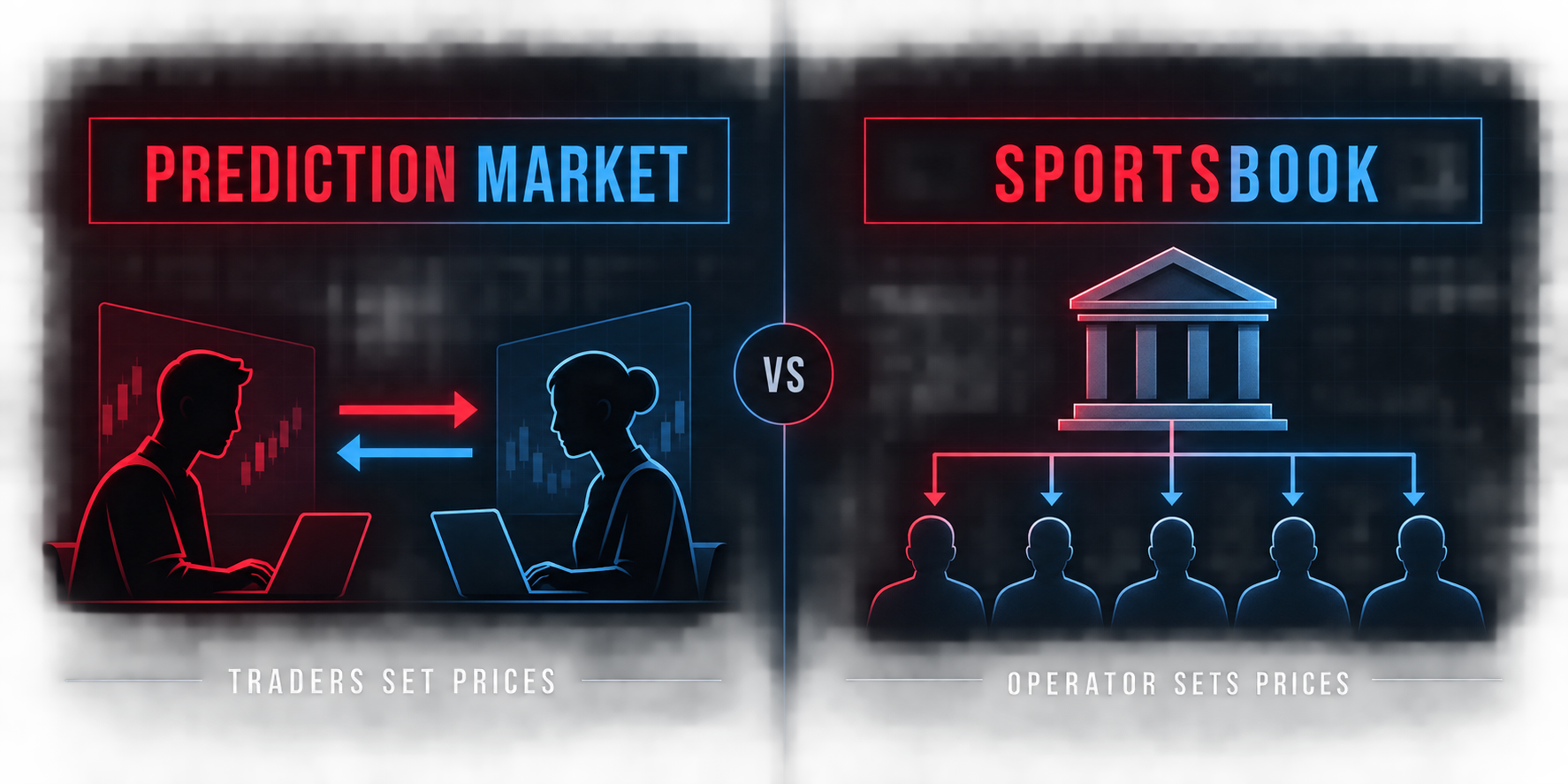
This is the single most important idea on this page, especially if you've used DraftKings or FanDuel. A sportsbook sets its own prices and builds its margin into them. On a prediction market, the exchange doesn't set the price. Traders do, through the orders they place. The exchange earns revenue from trading fees.
Your counterparty is another trader. Sometimes that's a professional market maker whose job is to keep prices quoted. Either way, the price reflects what people are willing to pay right now.
An implied probability is an estimate, not a fact. A 70¢ contract still loses three times out of ten.
Why do prediction market prices move?
Prices move when new information changes what traders expect. A new poll lands. A starting quarterback gets hurt. The National Weather Service issues a heat advisory. Traders reprice within seconds or minutes.
Worked example: selling before the event
You don't have to wait for Election Day. Using the example above:
- You bought 20 Yes contracts at 45¢ for $9.00.
- A new poll pushes the price to 60¢.
- You sell all 20 at 60¢ and receive $12.00. Profit: $3.00 before fees, with the race still undecided.
It works in reverse too. If the price falls to 30¢ and you sell, you get $6.00 back. That's a $3.00 loss.
Selling early depends on someone being willing to buy. In quiet markets, there may be few buyers near the price you want.
How do you read a prediction market contract?
Check three things before your first trade.
1. The resolution criteria. What exactly has to happen, measured by which source, and by what deadline? This is where most beginner mistakes happen.
Here's a Texas example. Kalshi's daily "Highest temperature in Houston" market settles on the reading at William P. Hobby Airport, not Bush Intercontinental and not your phone's weather app. It's also a bracket market: you pick a temperature range, such as 97°–98° or 99°–100°. If Bush Intercontinental hits 101° but Hobby tops out at 99°, the 99°–100° bracket pays. The rules page for every market lists its settlement source. Read it.
2. The current price. That's your starting estimate of the probability. Ask whether you think the true chance is higher or lower.
3. Volume and liquidity. Volume shows how much has traded. Liquidity shows how easily you can get in and out near the quoted price. A contract with little activity can show a price that moves on a single small order.
Prediction market vs. sportsbook: what's the difference?
| Prediction market | Sportsbook | |
|---|---|---|
| Who sets the price | Traders, through buy and sell orders | The sportsbook |
| Who's on the other side | Another trader | The sportsbook |
| How the platform earns money | Trading fees | A margin built into its prices |
| Can you exit early | Yes, by selling at the current price when there's a buyer | Only if the sportsbook offers a cash-out |
| Federal or state oversight | Federal: the CFTC | State gaming regulators |
| Available in Texas | Yes, as of September 2026 | No. Texas has not legalized sportsbooks |
Are prediction markets legal in Texas?
Yes, as of September 2026. Kalshi and Polymarket US are Designated Contract Markets (DCMs) regulated by the Commodity Futures Trading Commission (CFTC). That's the federal agency that oversees futures markets for things like oil, corn and interest rates. They operate under federal commodities law, not the state laws that govern sportsbooks.
Note that Polymarket US is the CFTC-regulated platform for American users. It is separate from Polymarket's international site.
What Texans should watch:
- In March 2026, Lt. Gov. Dan Patrick directed the Texas Senate State Affairs Committee to study prediction markets and how they fit with state law. Sports and election contracts drew the most attention.
- On September 15, 2026, the Senate and House State Affairs committees heard testimony from experts and industry representatives.
- The committee's recommendations are aimed at the 2027 legislative session. Texas holds no regular session in 2026.
- Texas has not taken enforcement action against Kalshi or Polymarket. Several other states have issued cease-and-desist orders or filed lawsuits against prediction market operators.
The rules could change. We update this page when they do. Is Kalshi legal in Texas? →
Who can trade prediction markets?
Every regulated platform checks three things at signup:
- Identity. You verify your name, address and date of birth, often with a government ID. This is called KYC ("know your customer").
- Location. The app confirms you're physically in an eligible state.
- Age. Each platform sets and verifies its own minimum age. TexasPredictionMarkets.com writes for, and recommends platforms only to, adults 21 and older.
Which prediction market platform should a Texan start with?
Short version:
- Kalshi — the widest range of markets and our default pick for most Texans.
- Polymarket US — deep political markets and strong liquidity.
- ProphetX — sports only.
- Crypto.com — built around its mobile app.
Compare all four platforms side by side → · Kalshi fees explained →
Affiliate links. See our disclosure.
Certain limitations apply. The offer is available to new users only, subject to the terms and conditions at kalshi.com/tc/500. 18+ only. Restrictions and eligibility requirements apply. Event contract trading involves significant risk and is not appropriate for everyone. Please carefully consider if it is appropriate for you in light of your personal financial circumstances. Kalshi products are not available in all jurisdictions. See kalshi.com/regulatory for more information.
Prediction market glossary
- Bid
- The highest price a buyer is currently willing to pay.
- Ask
- The lowest price a seller is currently willing to accept.
- Spread
- The gap between the bid and the ask. Tighter spreads usually mean a more active market.
- Market order
- An order that fills immediately at the best available price.
- Limit order
- An order that fills only at your chosen price or better. It waits in the order book until someone matches it.
- Liquidity
- How easily you can buy or sell near the quoted price without moving it.
- Volume
- The total number of contracts, or dollars, traded in a market.
- Open interest
- The number of contracts currently held and not yet settled.
- Market maker
- A trader, often a professional firm, that continuously quotes both buy and sell prices to keep a market active.
- Trading fee
- What the exchange charges per trade. Fee formulas differ by platform and sometimes by market category.
- CFTC
- The Commodity Futures Trading Commission, the federal agency that regulates US futures and event contract exchanges.
- Designated Contract Market (DCM)
- An exchange approved and supervised by the CFTC. Kalshi and Polymarket US hold this status.
- KYC (know your customer)
- The identity check every regulated exchange runs before you can trade.
- Geolocation
- The location check that confirms you're in an eligible state when you trade.
Event contracts on CFTC-regulated exchanges. 21+ only. Trade responsibly.
More: How does Kalshi work? · Are prediction markets legal in Texas? · Kalshi taxes for Texans · Fed rate decisions on Kalshi